Camera systems for forklifts
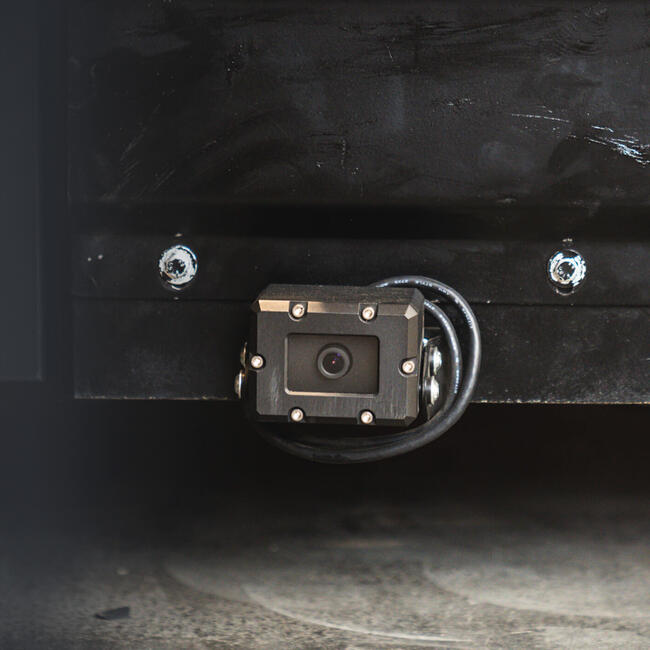
As technology advances, camera systems are increasingly becoming standard assistance systems for forklift drivers. They increase safety and improve visibility when maneuvering and storing goods. The driver can carry out his duties faster and more safely. Retrofit forklift cameras are now available for every forklift model.
There are many advantages to a camera fitted as standard or installed retroactively:
Due to their compact design, cameras can now be installed almost anywhere on the forklift. A multitude of manufacturers offer a wide selection of cameras, displays and accessories, including lights and radio links. These cameras differ in terms of quality, functions, size and price. We generally distinguish between the following types of cameras.
Provide a clear view of the route when transporting large-volume loads that would otherwise obscure the driver's view. The result is less manoeuvering and damage caused by handling.
Give the driver a bird's eye view, which is helpful when large loads are preventing a clear view ahead. Since the camera moves with the extendable mast, it is significantly easier to store goods safely and precisely.
Sit directly on the forks or on the fork carriage. These cameras give the driver a direct view of the loading process and assist the driver in picking up and unloading the transported goods safely and accurately. The driver can check whether the forks are gripping the pallets in the right place, which makes work in high racks in particular much easier.
These cameras secure the area behind the forklift. Drivers often have to reverse to manoeuver and are therefore reliant on seeing what is happening behind the truck.
Provide an all-round view of all areas around the truck. Since multidirectional trucks can also drive sideways and diagonally, this type of camera guarantees that the driver has an overview of the entire working area.
HUBTEX multidirectional trucks can be fitted with a variety of camera models in different positions. The best combination is selected for each application. Forklifts that come without a camera system can also be retrofitted with appropriate systems.
The following models and positions are available:
In order for the camera image to reach the driver, there are various ways in which the video images can be transmitted to the displays in the driver's cab.
The camera image is transmitted to the terminal via a Wi-Fi transmitter.
A radio link is set up between the camera and the monitor using a transmitter and a receiver.
The camera and monitor are connected by a cable.
The camera transmits directly via an integrated transmitter and the corresponding receiver is located in the display.
Optionally, the camera can be displayed via the HUBTEX HIT. A second screen is not necessary since all important information is shown on the HIT display. It is then possible to show several cameras on the display at the same time (split screen) or to switch back and forth between the individual cameras. The monitor can be split between 3 or more cameras.
Cameras for forklift trucks are no ordinary cameras, they have to meet the special requirements of your application.
They are therefore: